2026-10-26
Learning new topics just got faster

With an AI tutor such as Claude, I now learn hard topics much faster. Before, I needed a few hours of books, classes and videos before I could work with the core ideas. Now I need a few minutes. In this post, I explain my method, using the SpaceX Raptor engine as an example.
Learning is a big part of how I spend my solo time. I enjoy learning about a wide range of topics, such as physics, math or economics. I love the feeling of being deeply engaged with the core ideas, the feeling of minutes turning into hours without realizing the passage of time.
How I used to learn
I've always been a practical learner: I can read the same concept multiple times and barely remember it, but once I engage with it in a playful simulation it's permanently burned into my brain. Until one year ago the fastest way I learned was to use just enough YouTube videos, online classes1, books2, blog posts or papers so that I could code a simulation3. I find all these methods effective, but they require a lot of my attention and dedication, meaning I can only engage a few times per week. This has changed drastically in the past year. Before, I had to build each simulation myself. Most of that time went into details that were not about the topic, such as how to draw a pipe or why my code had a bug. Now the tutor builds the simulation in a few minutes. I spend all my time on the core ideas: I change the simulation, ask a question, and see the result as fast as I can think of the next question.
In a post from 2025, I wrote that LLMs make coding less interesting, because they do the thinking for me. Learning is different. The tutor does the work that is not the topic, and I keep the thinking.
My method now
The method I'm now using is jumping directly to the core ideas of the topic in a conversation with an AI tutor. I use Claude, but other AI tutors can do the same. I use the explainer style of Bartosz Ciechanowski, one of my favorite bloggers of all time. My favorite of his posts is Mechanical Watch.
Step 1. Ask the tutor for the simplest possible explainer page. An explainer page is a single web page with text and diagrams. The tutor makes it for you (Claude calls it an artifact). Suppose I want to learn how the Raptor engine works. I would start with a simple prompt like:
How does a rocket engine work? Let's take the Raptor Engine from SpaceX. I want you to create the simplest possible explainer with a very simple figure. I'll guide you where to go from there.
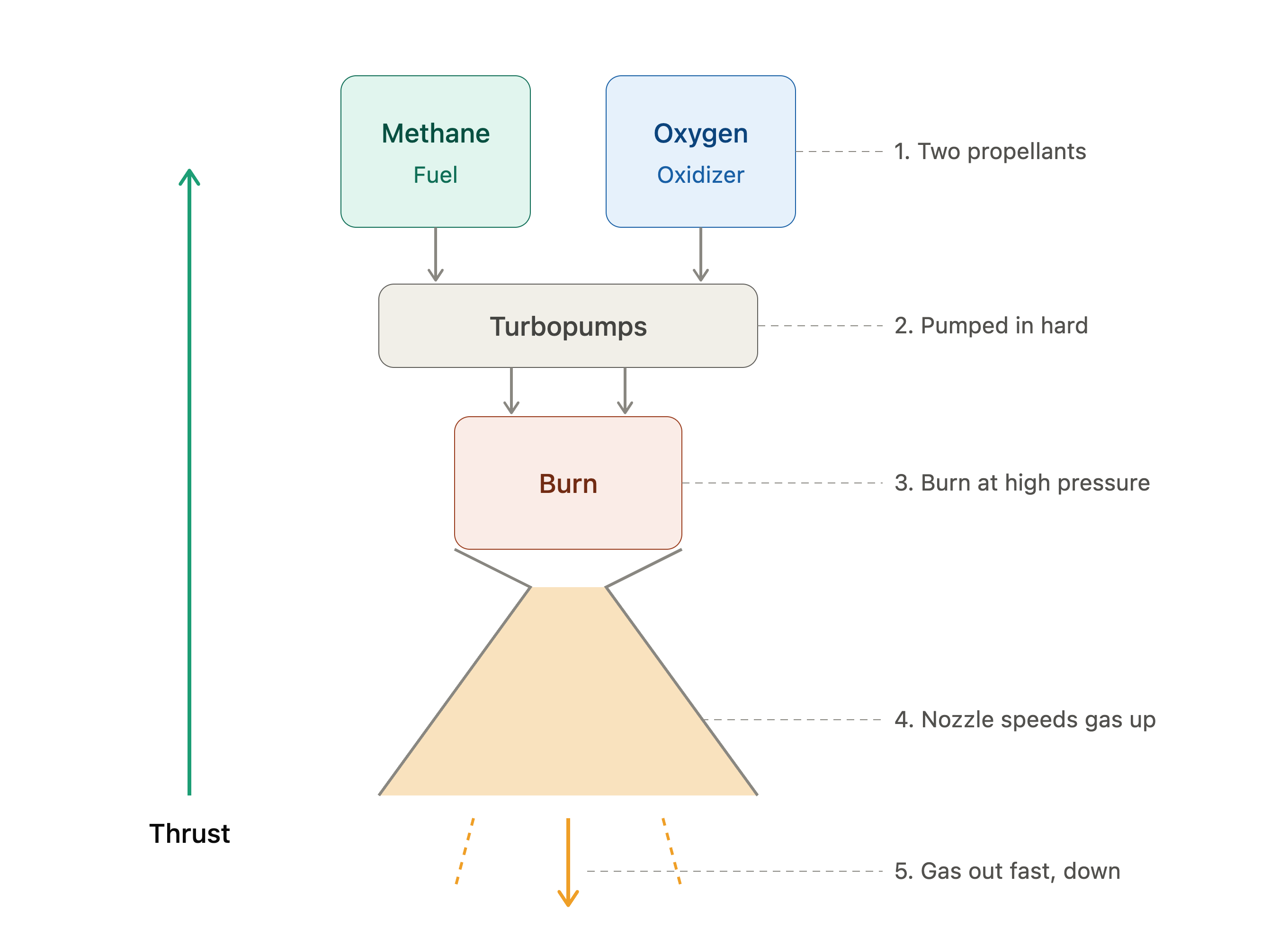 Simple diagram of a Raptor engine: methane and oxygen go through turbopumps, burn at high pressure, and the nozzle pushes the gas out fast to make thrust
Step 2. Once the components and their relationships are clear, I expand.
We need to make the diagram a little more complete with all the main components, for example how is the nozzle prevented from melting? How are the fluids injected into the combustion chamber? We'll do a simple 2D visualization complete with all the real components.
The tutor then adds all the main components of the full-flow cycle: the fuel and oxygen pumps, the turbines, the two preburners, the main injector, the cooling jacket, the combustion chamber and the nozzle.
Step 3. The next step is the most rewarding: keep expanding whatever sparks my curiosity. I add a comment to any part of the page, and the tutor answers it. There's no set amount of time here, only the occasional subscription token limit stops me.
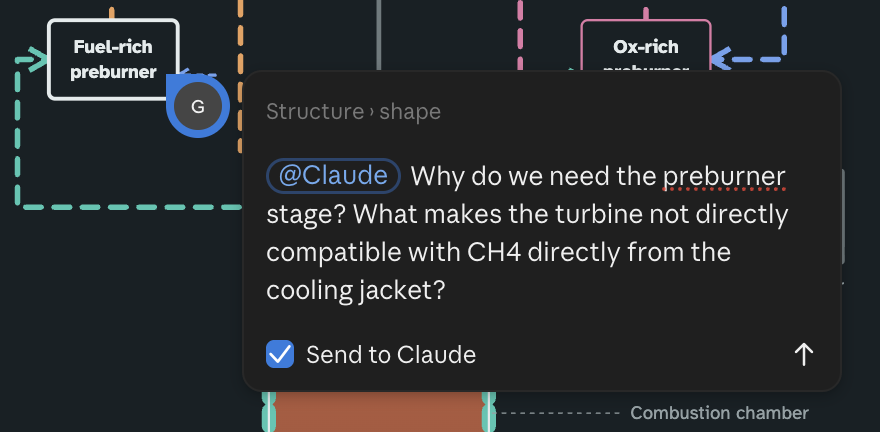 A comment on the fuel-rich preburner in the explainer page, sent to Claude. It will quiz me on this later
I keep going until the explainer page answers all my questions. Often I start tangents, for example analyzing how a specific component works: Raptor engine turbopump.
Step 4. When I think I understand the topic, I ask the tutor to quiz me. The quiz finds the parts that I only think I know. Before, a working simulation told me that I understood a topic. Now the quiz does that job.
Quiz me on the Raptor engine. Ask one question at a time and wait for my answer. Do not tell me the answer before I try.
Step 5. Furthermore, now that the tutor is really good at 3D modeling, I often repackage the simplified concepts into a realistic 3D model in order to appreciate how all the concepts I learned fit together as a physical object that I can now understand (and could 3D print if I wanted to).
Conclusions
The example I presented is inherently visual, but this method works well for any hard topic4. I find this activity extremely effective in teaching me complex concepts. What I like most about it is that it's extremely addictive in all the possible good ways: it requires very little activation energy. Got a question? Turn a 30-minute trip to the airport into a learning session! I've never experienced that much engagement with an arbitrary topic. I'm now learning as fast as I can think about new topics.
Footnotes
Some of my favorite online classes: Cryptography I, Stanford, Game Theory, Stanford. ↩︎
Good physics books I've learned from: The Biggest Ideas in the Universe by Sean M. Carroll, QED: The Strange Theory of Light and Matter by Richard Feynman. More in my bookshelf. ↩︎
Simulations I used to prove to myself that I understood enough of a topic: life simulation, electromagnetic field, Raft in Rust. ↩︎
These are some of the topics I've studied this week: